You know that feeling in February when you touch a doorknob and get shocked, your lips are cracked no matter how much water you drink, and your hardwood floors have developed little gaps you could swear weren't there in October? That's not just bad luck. That's physics.
Cold outdoor air holds almost no moisture. When you pull -10°F air into your home and heat it to 70°F, the relative humidity of that air drops to 10–20% — drier than the Sahara Desert. Your forced air system then cycles that parched air through the house continuously, day and night, all winter long. A whole-home humidifier is the fix. Here's everything you need to know.
Why the Midwest Winters Are So Hard on Indoor Air
The dryness problem in the Midwest isn't just a comfort issue — it causes real damage to your home and your health. When indoor humidity drops below 30%:
- Hardwood floors gap and can crack along the grain
- Wood furniture joints loosen (that wobbly chair isn't old, it's dry)
- Static electricity becomes a constant annoyance throughout the house
- Respiratory passages dry out, which researchers believe increases susceptibility to respiratory viruses
- Skin, lips, and sinuses take a beating that no amount of lotion fully fixes
The target indoor relative humidity for a Midwest winter is 30–40%. Below 30% is uncomfortable and damaging. Above 50% in winter risks condensation on windows and in wall cavities, which creates its own problems. A whole-home humidifier with a decent humidistat holds you in that range automatically.
How a Whole-Home Humidifier Actually Works
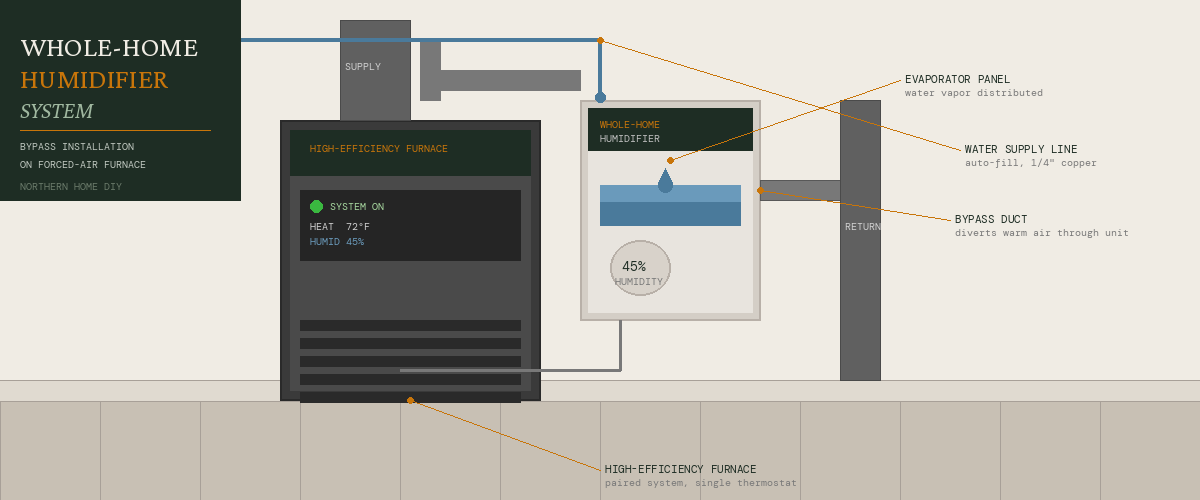
A whole-home humidifier mounts on the supply or return plenum of your furnace ductwork. As heated air passes through, water flows over a humidifier pad (called a water panel or evaporator pad), evaporates into the airstream, and distributes moisture throughout the house via your existing ductwork.
Unlike a portable room humidifier sitting on your nightstand:
- It connects directly to your water supply line — no refilling
- It treats the entire house through ducts you already have
- It runs automatically based on a humidistat, like a thermostat but for humidity
- Maintenance is minimal: one pad replacement per heating season
The three main types you'll see:
Bypass humidifiers use the pressure differential between supply and return ducts to move air through the water panel. Most common, most affordable, and reliable for most homes. They require the furnace blower to be running to humidify — so they work in tandem with your heat cycles.
Fan-powered humidifiers have their own internal blower. They can humidify even when the furnace isn't actively heating and produce 30–50% more moisture output than bypass models — better for larger homes or homes that run very dry.
Steam humidifiers heat water to produce steam, which is then distributed through the duct system. Most effective, most expensive to buy, and most expensive to operate (they use electricity to boil water constantly). Worth it in specific situations — very large homes, homes with extreme dryness issues, or when someone in the house has respiratory conditions requiring precise humidity control.
Which Type Should You Buy?
For most Midwest homes in the 1,500–3,000 sq ft range, a fan-powered humidifier hits the sweet spot of performance and cost. The Aprilaire 700 Whole-Home Humidifier on Amazon → is what we installed in our new build and it's performed exactly as advertised — no more static shocks, floors are stable, and the humidistat holds steady at 35% even during the worst cold snaps.
The Honeywell Home HE360A on Amazon → is the other go-to recommendation and works equally well. Both are installed by HVAC contractors regularly and have good parts availability for long-term maintenance.
If you have a smaller home (under 1,500 sq ft) or a tighter budget, a quality bypass model like the Aprilaire 600 on Amazon → does the job for less. Just make sure the furnace runs often enough to keep up with demand — in very cold stretches, a bypass model on a well-insulated home with a modulating furnace may not cycle enough to maintain target humidity.
For a large home or someone with specific respiratory needs, the Aprilaire 800 Steam Humidifier on Amazon → is the premium answer. It costs more up front and more to operate, but it doesn't depend on your furnace running and maintains humidity more precisely.
What Installation Looks Like — and What It Costs
In a new build, a whole-home humidifier is a straightforward add-on at the same time as the furnace. Your HVAC contractor mounts it to the plenum, taps into a nearby water line, and connects the humidistat to the thermostat system. Budget $300–$700 for unit plus install, depending on model and your market.
Retrofitting into an existing forced air system is also relatively simple. An HVAC tech or plumber can typically complete it in 2–3 hours. The main requirements: access to a water supply line near the furnace and a return or supply plenum to mount the unit.
Rough cost by type:
- Bypass humidifier: $200–$400 unit + $100–$300 install
- Fan-powered: $350–$600 unit + $150–$300 install
- Steam: $700–$1,200 unit + $300–$500 install
The Maintenance You'll Actually Have to Do
This is where whole-home humidifiers earn their keep. Annual maintenance takes about 20 minutes total:
- Replace the water panel once a year at the start of heating season. Replacement pads run $15–$30 and slide right in. Aprilaire replacement pads on Amazon → are the ones we use.
- Drain and flush the unit at season end when you shut it off for summer. Sitting water breeds scale and bacteria.
- Adjust the humidistat seasonally — run 30–35% relative humidity when it's below -10°F outside, and 40–45% when temps are above 20°F. Higher settings during extreme cold cause condensation on windows.
- Check the distribution tray and drain pan once per season for scale buildup, especially if you have hard water.
That's genuinely it. Most units run 10–15 years without major service. It's one of the lowest-maintenance things you can add to a forced air system.
The Bottom Line
If you have a forced air heating system in the Midwest and you spend significant time in your home during winter — which is most of us, for most of October through April — a whole-home humidifier is worth it. Full stop.
The combination of long winters, extreme cold, and forced air heat creates the most severe indoor dryness conditions in the country. A portable humidifier running in one room is fighting the wrong battle. A whole-home unit solves it at the source.
For most homes, start with the Aprilaire 700 fan-powered model →. Have it installed when your furnace is serviced, or add it as a retrofit this fall. It's one of the best quality-of-life upgrades you can make to a Midwest home for under $1,000.